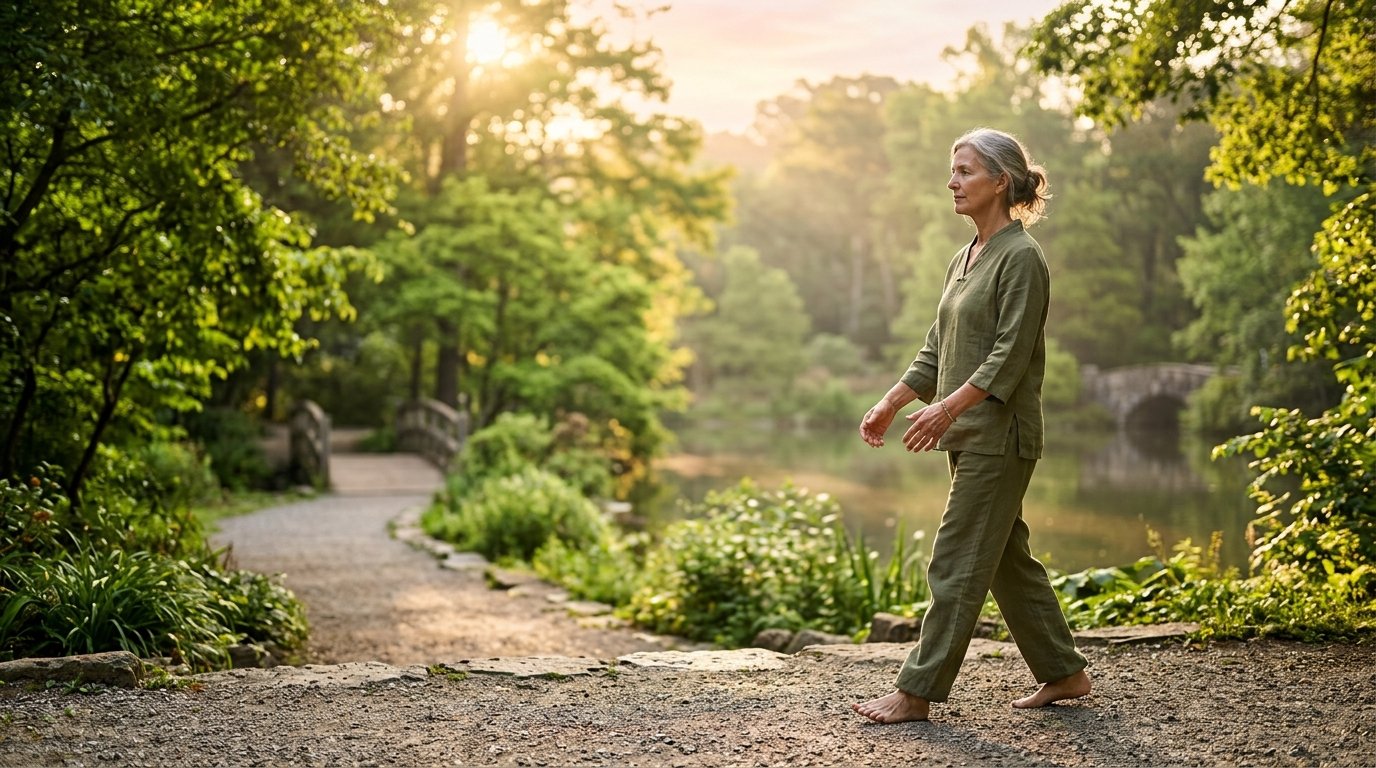
Most people assume you need to sweat, sprint, or lift something heavy to get real health benefits from movement. Tai chi walking quietly breaks that rule. It looks almost too gentle to matter a few slow, deliberate steps, weight shifting from heel to toe, arms floating at your sides. Yet researchers keep finding that this “boring” practice does something surprising: it retrains balance, calms the nervous system, and strengthens the small stabilizer muscles that everyday workouts often skip.
If you’ve searched for tai chi walking benefits, you’re probably one of three people: someone worried about falling, someone managing joint pain or stress, or someone simply curious why physical therapists and older adults swear by it. This guide covers what the practice actually is, what the evidence really shows (including its limits), and how to start safely — without the fluff.
What Is Tai Chi Walking, Exactly?
Tai chi walking is a slow, mindful stepping pattern borrowed from traditional tai chi forms. Instead of walking at a normal pace, you shift your body weight fully onto one leg, place the other foot down heel-first with control, and only then transfer your weight forward. Breathing is slow and coordinated with each step, and attention stays on posture, alignment, and balance rather than speed or distance.
It’s sometimes taught as a standalone practice for beginners, seniors, or people in rehabilitation, and other times as one component within a full tai chi form such as Yang-style or Sun-style tai chi. It’s worth being honest here: most of the strongest research studies complete tai chi programs, not the walking drill in isolation. Tai chi walking is a foundational piece of that larger practice, and it shares many of the same mechanisms, but it isn’t a separately validated “mini workout” with its own body of clinical trials.
The Real, Evidence-Backed Benefits
1. Better Balance and Lower Fall Risk
This is where the research is strongest. Multiple systematic reviews and meta-analyses of randomized controlled trials have looked at tai chi’s effect on balance in older adults. One 2023 analysis of 24 trials found that regular tai chi practice reduced fall risk and improved balance measures such as the Timed Up and Go test and functional reach test, with stronger effects the more often people practiced. A separate 2025 meta-analysis reached a similar conclusion, linking tai chi to improved balance ability, walking speed, and confidence in avoiding falls.
Not every study agrees, though. Some trials, particularly in healthy (not high-risk) older adults, have found smaller or inconsistent effects. The honest summary: tai chi appears to help balance and reduce falls for many older adults, especially those already at risk, but it isn’t a guaranteed fix for everyone.
2. Joint-Friendly Strength Training
Because the movements are slow and low-impact, tai chi walking is often recommended for people with arthritis or joint pain who can’t tolerate running or heavy resistance training. The controlled weight shifting activates deep stabilizer muscles around the hips, knees, and ankles without the jarring impact of regular walking or jogging. In one widely cited arthritis study involving over 350 participants, an 8-week tai chi program led to meaningful reductions in pain and stiffness, along with better ability to manage daily tasks like climbing stairs.
3. Stress Reduction and Nervous System Calm
Slow breathing paired with deliberate movement is a well-known way to activate the parasympathetic nervous system the “rest and digest” state that lowers heart rate and cortisol. Tai chi walking combines this breathing pattern with gentle physical focus, which is likely why so many practitioners describe it as “moving meditation.” It won’t replace therapy or medication for anxiety, but as a daily stress-management habit, it’s low-risk and accessible.
4. Sharper Focus and Coordination
Learning and repeating a stepping sequence isn’t purely physical it also engages memory, attention, and coordination. Some research on tai chi programs suggests this kind of combined mental-and-physical activity supports executive function (planning, multitasking, problem-solving) more than passive or purely aerobic exercise alone. This is one reason tai chi is often recommended alongside other cognitive-health habits for older adults.
5. Better Sleep Quality
Several studies on tai chi in older populations report improved sleep quality, likely a downstream effect of lower stress and more consistent daily movement rather than a direct, isolated mechanism. If you struggle with a racing mind at bedtime, a short tai chi walking session earlier in the evening may help more than scrolling your phone.
Tai Chi Walking vs. Regular Walking vs. Yoga
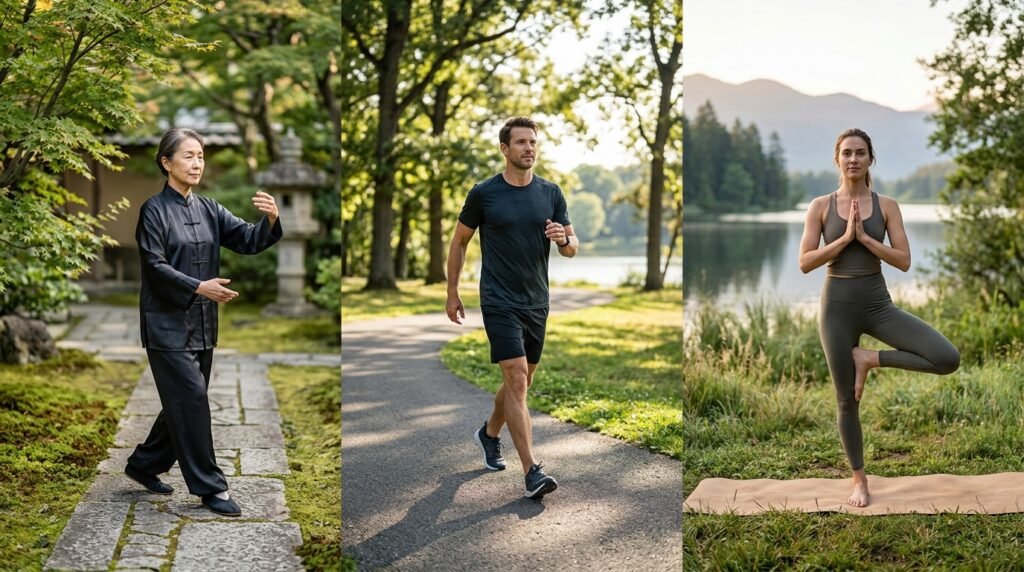
People often want to know how tai chi walking stacks up against other low-impact options. Here’s a realistic comparison:
| Factor | Tai Chi Walking | Regular Brisk Walking | Yoga |
|---|---|---|---|
| Balance & fall prevention | Strong evidence, especially for older adults | Some benefit, less targeted | Moderate benefit |
| Cardiovascular fitness | Low — not a substitute for aerobic exercise | Strong if done briskly | Low to moderate |
| Joint impact | Very low | Low to moderate | Very low |
| Flexibility | Moderate | Low | Strong |
| Stress reduction | Strong | Moderate | Strong |
| Equipment needed | None | Walking shoes | Mat (optional) |
| Beginner accessibility | Very high | Very high | Moderate |
The takeaway: tai chi walking is not meant to replace brisk walking for cardiovascular fitness. Instead, think of it as a complementary practice — one that targets balance, joint health, and calm in ways a regular walk doesn’t fully cover.
People can also read this: 15 Small Living Room Decorating Ideas That Actually Work
Who Benefits Most
- Older adults concerned about balance or falling
- People with arthritis or joint pain seeking gentle movement
- Anyone recovering from injury or surgery who needs low-impact rehab exercise
- People with chronic stress, tension, or mild anxiety
- Beginners who want an accessible entry point into mindful movement
- Anyone whose current routine lacks balance and stabilizer training
How to Start Tai Chi Walking Safely
- Wear flat, supportive shoes or practice barefoot on a non-slip surface.
- Start near a wall or sturdy chair if your balance is uncertain, so you have something to hold if needed.
- Move slower than feels natural. The benefit comes from control, not speed.
- Coordinate breath with steps — inhale as you shift weight back, exhale as you step forward.
- Practice 10–15 minutes a day to start; consistency matters more than duration.
- Consider a local class or instructor-led video for proper form, especially in the first few weeks.
If you have a significant balance disorder, recent surgery, or a neurological condition, check with a doctor or physical therapist before starting any new movement practice, tai chi included.
A Balanced Look at the Limitations
It’s worth being upfront: tai chi walking is not a miracle cure, and the research reflects that.
- It is not a substitute for cardiovascular exercise like brisk walking, cycling, or swimming.
- Results take weeks to months of consistent practice, not days.
- Some clinical trials in healthy (low-risk) populations have found smaller effects than trials involving people already at high fall risk.
- Most rigorous studies test full tai chi programs, not the walking drill alone, so claims specific to “tai chi walking” should be read with that context in mind.
Treating it as one useful tool in a broader routine alongside strength training, cardio, and good sleep habits is a more realistic expectation than treating it as a stand-alone fix.
Final Thoughts
Tai chi walking earns its reputation the slow way: not through dramatic transformation, but through steady, well-documented improvements in balance, joint comfort, and stress levels. It’s one of the few forms of movement that’s genuinely accessible to almost anyone, regardless of age or fitness level, and the evidence behind its core benefits — particularly fall prevention in older adults is more solid than most wellness trends. Start small, stay consistent, and treat it as one piece of a balanced movement routine rather than a cure-all.
FAQs
Is tai chi walking good for beginners?
Yes. It requires no equipment, no prior fitness level, and can be practiced at home. Most people can learn the basic stepping pattern within a single session, though refining form takes longer.
How long before I notice benefits from tai chi walking?
Balance and mobility improvements are typically reported after 8 or more weeks of consistent practice, based on clinical studies using similar timeframes. Stress-related benefits, like feeling calmer after a session, can appear much sooner.
Can tai chi walking replace my daily walk?
Not for cardiovascular fitness. It’s low-intensity by design, so it works best as an addition to not a replacement for brisk walking or other aerobic exercise.
Is tai chi walking safe for people with arthritis?
Generally yes, since it’s low-impact and doesn’t jar the joints. Some studies on tai chi programs for arthritis report reduced pain and stiffness after several weeks. Check with your doctor if you have severe joint damage or a flare-up.
Do I need a class to learn tai chi walking?
Not necessarily, but an instructor or well-made video can help you avoid form mistakes early on, especially with weight-shifting and posture. Many community centers and senior programs offer beginner classes.
Does tai chi walking help with anxiety or stress?
Many practitioners and some research point to reduced stress and improved calm, largely through slow breathing and focused attention. It’s a helpful daily habit, but it shouldn’t replace professional care for diagnosed anxiety disorders.
For more updates visit: FUNDLY