You’ve crashed a toy drone into a wall. Or maybe you’ve watched your cousin’s cinematic aerial shots and thought, “I could never fly something that expensive.” Either way, that’s exactly the gap DJI built the Flip to close — a camera drone that folds down to the size of a water bottle, launches from your palm, and still shoots footage good enough to post without apology.
So, if you’re trying to decide whether the DJI Flip drone deserves a spot in your travel bag, this guide covers everything that actually matters: real specs, real pricing, who it’s built for, and where it falls short. In other words, no filler, and no recycled press-release copy.
What Is the DJI Flip Drone?
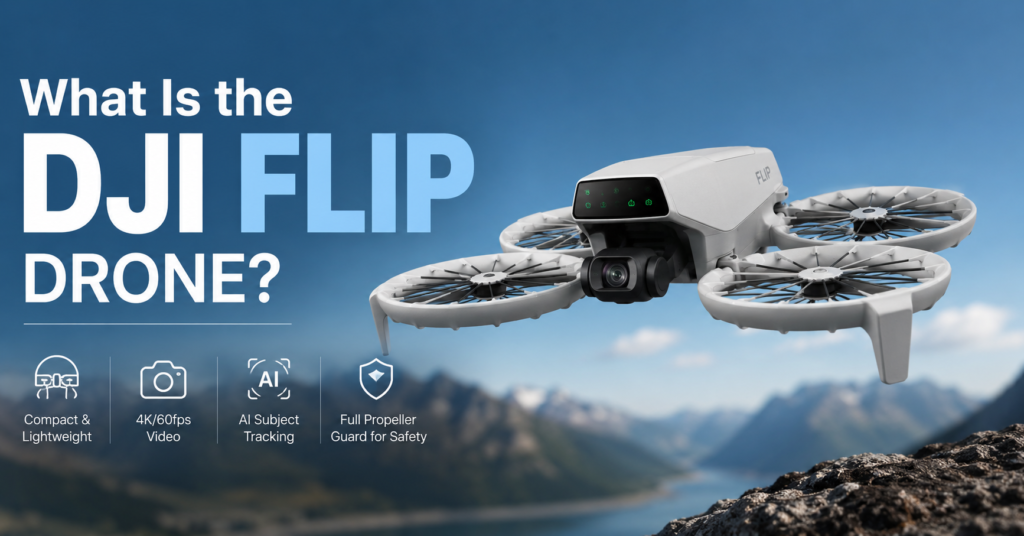
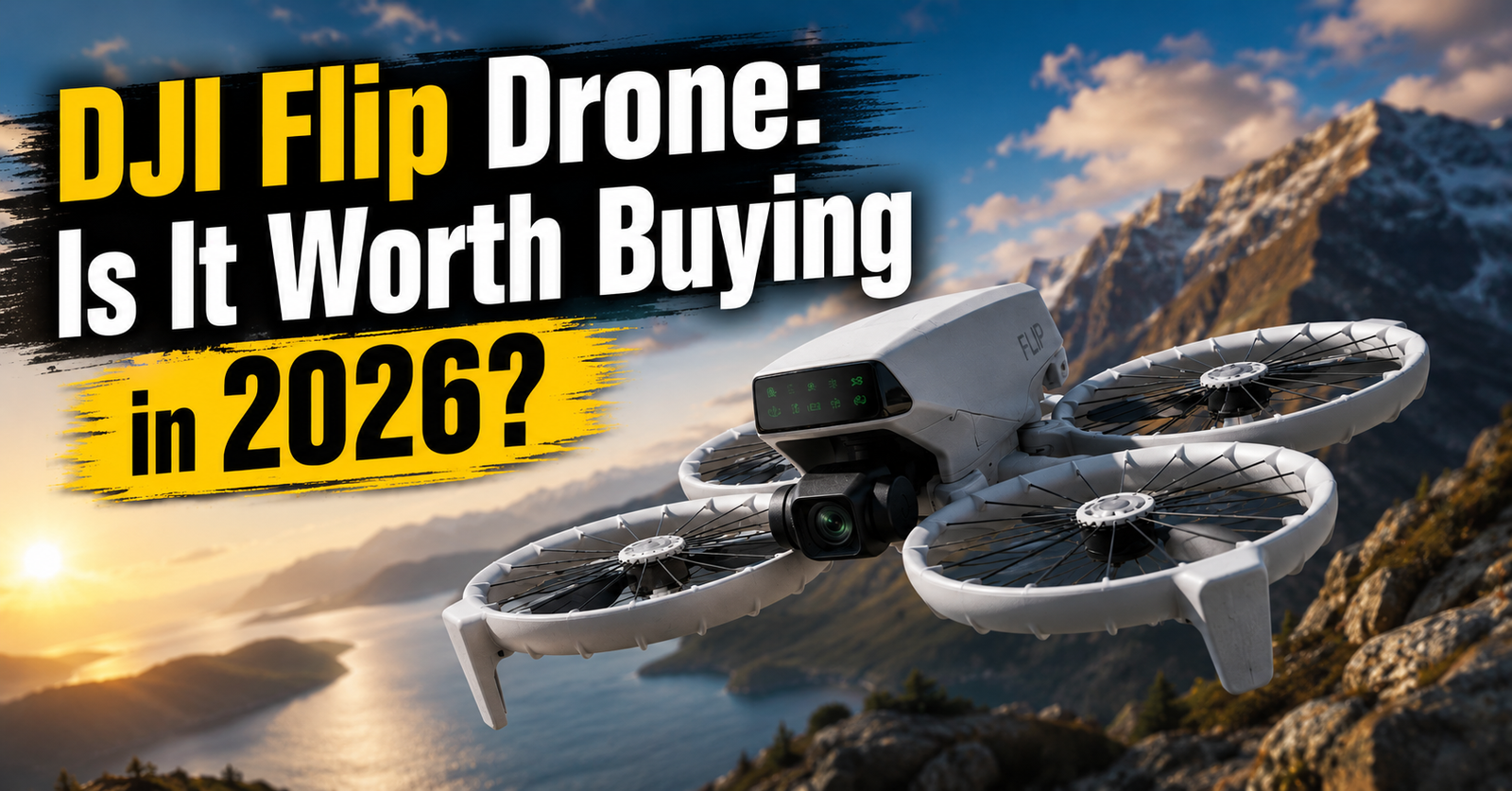
To begin with, the DJI Flip is a sub-249-gram foldable camera drone that DJI launched in January 2025. Essentially, it sits between the ultra-cheap DJI Neo and the more advanced DJI Mini 4 Pro, so it borrows the Neo’s beginner-friendly simplicity while pairing it with a camera system closer to what you’d expect from the Mini line.
However, what makes it stand out isn’t raw power — it’s the design. For instance, the Flip uses a full-coverage propeller guard that folds flat around the drone body, so the propellers are almost never exposed. As a result, that single design choice is why DJI markets it as the drone you can hand to a first-timer without wincing.
Quick Snapshot
Below is a quick look at the core specs:
| Feature | Detail |
|---|---|
| Weight | Under 249 g |
| Camera sensor | 1/1.3-inch CMOS, 48 MP stills |
| Video | 4K/60fps HDR, optional 10-bit D-Log M |
| Lens | 24mm equivalent, f/1.7 |
| Max flight time | Up to 31 minutes |
| Gimbal | 3-axis mechanical stabilization |
| Launch options | Palm launch, voice control, remote controller |
| Starting price | $439 (drone + RC-N3 controller) |
Design: Why the Propeller Guard Matters
First of all, most beginner mistakes with drones happen in the first ten minutes — a clipped finger, a snapped propeller, a drone that flips into a bush. To solve this, DJI’s answer with the Flip is a foldable cage-style guard that wraps around all four propellers. Then, once you unfold it, the drone powers on automatically. Overall, it’s a small detail, but it removes the most common source of anxiety for new pilots.
That said, this isn’t just marketing dressing. In practice, it genuinely changes how the drone can be used — indoors, around kids, and in tight spaces where a standard Mini-series drone would feel risky.
Camera and Video Quality
To start, this is where the DJI Flip earns its price tag. Specifically, the 1/1.3-inch sensor is noticeably larger than what you’d find on budget drones in this weight class, and as a result, it shows in low light and dynamic range.
Below are the key camera highlights:
- 48 MP stills, plus up to 4x digital zoom
- 4K video at 60 frames per second, plus 100fps slow motion
- 10-bit D-Log M color profile, useful for creators who want to color grade footage in post
- 3-axis mechanical gimbal, which delivers smooth, professional-looking stabilization
In short, for vloggers and social content creators, this is genuinely more capable than what most people need. Whether it’s a phone screen, a YouTube upload, or a small-format video project, the footage holds up either way.
Flight Time and Range
Overall, DJI rates the Flip at up to 31 minutes of flight time on a single battery — a strong number for a drone this size. That said, in real-world use, expect closer to 25–28 minutes once you factor in wind, aggressive maneuvers, or cold weather, which is normal for any consumer drone.
Meanwhile, video transmission range varies by region:
- Up to 20 km in FCC-regulated regions (like the US)
- Up to 10 km in CE, SRRC, and MIC regions (much of Europe and Asia)
Even so, for most everyday use — parks, hikes, coastal shots — you’ll never come close to testing that range limit.
Control Options: Palm, Voice, or Remote
To begin with, one of the more distinctive things about the DJI Flip drone is how many ways you can fly it. Specifically:
- Palm control — take off, land, and perform basic gestures directly from your hand
- Voice control — start recording or launch simple maneuvers with spoken commands
- Mobile app control — fly using your phone as the interface
- Physical remote controller — either the standard RC-N3 (uses your phone as the screen) or the upgraded RC 2 with a built-in display
Overall, this flexibility is a big part of why the Flip appeals to people who’ve never flown a drone before. For example, you can start with palm control to get comfortable, then graduate to the remote as your confidence grows.
DJI Flip Price and Configurations
To sum up, pricing depends on which controller and accessory bundle you choose, as shown below:
| Configuration | What’s Included | Starting Price |
|---|---|---|
| DJI Flip (RC-N3) | Drone, RC-N3 controller, 1 battery | $439 |
| DJI Flip (RC 2) | Drone, RC 2 controller with built-in screen, 1 battery | $639 |
| DJI Flip Fly More Combo | Drone, RC 2, 2 extra batteries, charging hub, carrying bag | $779 |
That said, prices have occasionally dropped below MSRP during major sale events. So, it’s worth checking DJI’s official store or a major retailer before buying, since promotional pricing changes throughout the year.
DJI Flip vs. Neo vs. Mini 4 Pro: Which Should You Buy?
To begin with, this is the question most shoppers actually land on. Here’s a simple breakdown:
- Go with the DJI Neo if budget is your top priority and you mostly want casual, close-range flying — it’s the cheapest way into DJI’s ecosystem.
- Pick the DJI Flip, on the other hand, if you want a real camera drone with strong image quality, better crash protection than the Mini series, and flexible control options — ideal for travelers and content creators who want confidence, not complexity.
- Opt for the DJI Mini 4 Pro if you need advanced omnidirectional obstacle avoidance, longer range, and top-tier image quality, and you’re comfortable paying more for it.
Even so, the Flip’s obstacle sensing is more limited than the Mini 4 Pro’s — it relies on downward and forward sensing rather than full 360-degree coverage. That’s a real trade-off worth knowing before you buy, especially if you plan to fly in cluttered environments like forests.
Who Should Buy the DJI Flip Drone?
Overall, the Flip makes the most sense for the following buyers:
- First-time drone owners, since it’s forgiving but not toy-like
- Travelers, because it’s compact and foldable enough to survive being tossed in a backpack
- Content creators and vloggers, who want strong 4K footage without learning a complex flight system
- Parents or gift buyers, since it’s safer around people than a standard prop-exposed drone
On the other hand, it’s a weaker fit for professional filmmakers who need advanced tracking, full obstacle avoidance, or the longest possible range — the Mini 4 Pro or Air series serves that crowd better.
Common Limitations to Know Before Buying
To be fair, no drone is perfect, and being upfront about weaknesses matters more than pretending there aren’t any. Specifically:
- Obstacle avoidance is not omnidirectional, so care is still needed around trees, wires, and buildings
- Performance in strong wind can be inconsistent, since some users have reported this with any sub-250g drone
- The base package’s RC-N3 controller requires your own smartphone, which some buyers find less convenient than a built-in screen
Still, none of these are dealbreakers for the drone’s intended audience — but they do matter if you’re expecting flagship-level performance at a mid-range price.
Final Verdict
Ultimately, the DJI Flip drone isn’t trying to be DJI’s most advanced product — it’s trying to be the one you’ll actually use. Together, the full propeller guard, palm launch, and voice control lower the barrier to entry, while the 48 MP sensor and 4K/60fps video keep the footage genuinely worth sharing. So, if you want a capable, travel-ready camera drone without a steep learning curve, the Flip is one of the easiest recommendations in DJI’s current lineup.
FAQs
1. What is the DJI Flip drone used for?
Essentially, it’s designed for aerial photography, travel content, vlogging, and casual flying. In addition, its beginner-friendly controls and safety guard make it a popular choice for first-time drone owners.
2. How much does the DJI Flip cost?
To start, pricing begins at $439 for the drone with the RC-N3 controller. Beyond that, the RC 2 bundle costs $639, and the Fly More Combo with extra batteries runs $779.
3. Do I need a license to fly the DJI Flip?
Generally, drones under 250 grams have relaxed registration requirements in most regions, but rules vary by country. Therefore, always check your local aviation authority (like the FAA in the US) before flying, since regulations can change.
4. How long does the DJI Flip’s battery last?
Overall, DJI rates it at up to 31 minutes per battery under ideal conditions. However, real-world flight time is usually a bit shorter due to wind and temperature.
5. Is the DJI Flip good for beginners?
Yes, absolutely. Specifically, its full propeller guard, palm-launch feature, and voice control were designed to make it approachable for people who’ve never flown a drone before.
6. What’s the difference between the DJI Flip and DJI Neo?
In comparison, the Flip has a larger camera sensor, better video quality, and more control options, but it costs more than the Neo. Ultimately, the Neo is better suited to those who want the cheapest possible entry point.
For more updates visit: FUNDLY