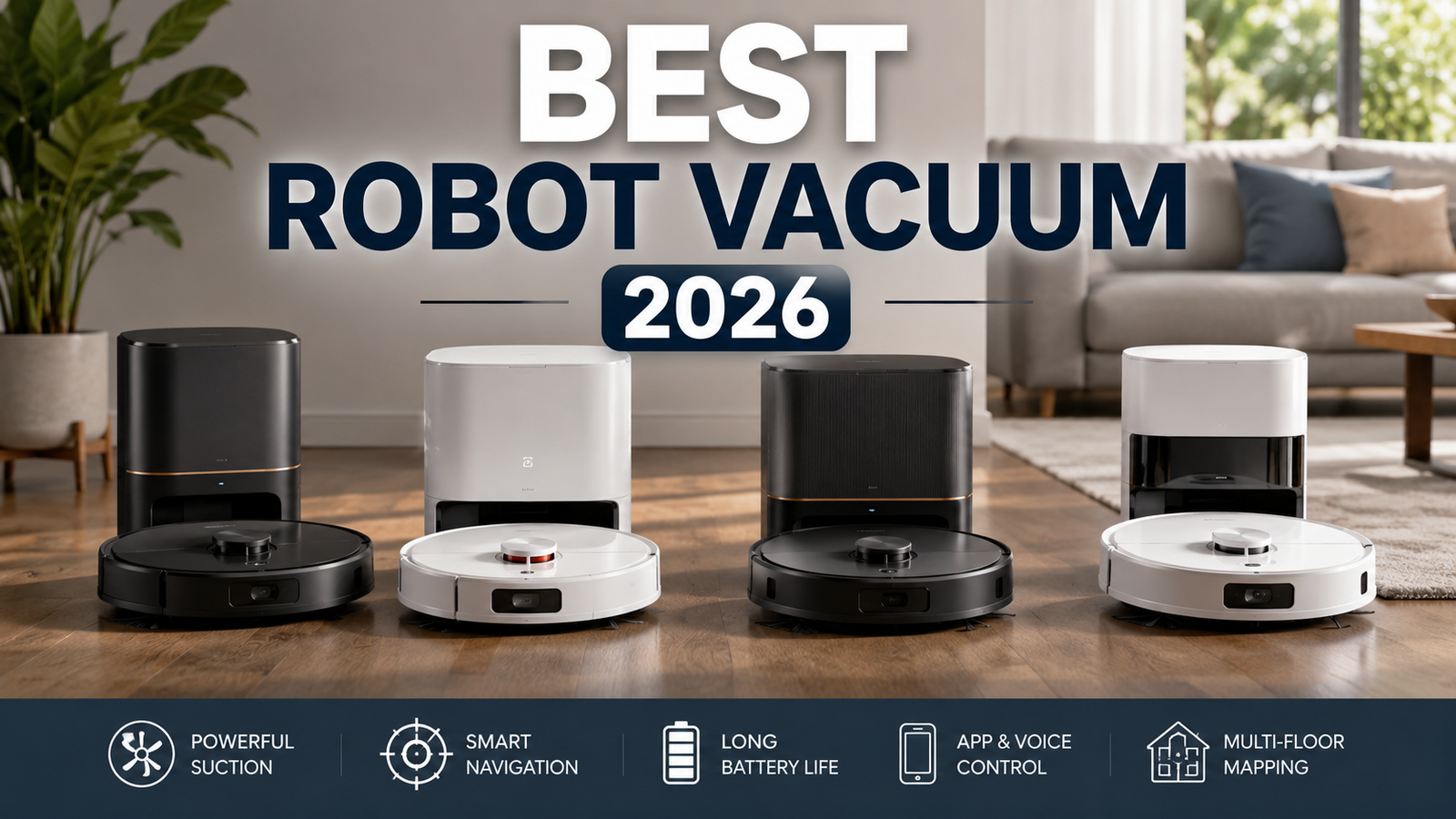
Cheerios under the couch. Kitty litter tracked across the hallway. A dog that sheds like it’s a full-time job. If you’ve ever stood in your living room wondering whether a robot vacuum can genuinely handle your mess, you’re asking the right question because in 2026, the answer depends a lot less on marketing and a lot more on which robot you pick.
In fact, the robot vacuum market has changed fast this year. Prices have dropped, and obstacle avoidance has gotten noticeably smarter. On top of that, one of the biggest names in the industry, iRobot, filed for Chapter 11 bankruptcy in December 2025 before a Chinese manufacturer stepped in to acquire the business. As a result, that single event has reshuffled who the “safe” brands are. So instead of repeating last year’s list, this guide is built around what independent testers and real users are actually seeing right now.
Quick Answer: The Best Robot Vacuum 2026 Picks
If you only have a minute, here’s the short version.
- Best overall: Roborock Saros 10R — top-tier obstacle avoidance with a low profile
- Best premium all-rounder: Dreame X60 Max Ultra Complete — strong across every testing category
- Best value: ECOVACS DEEBOT T80S Omni — near-premium performance at a mid-range price
- Best budget: Eufy Omni C28 — reliable basics without the extra cost
- Best for most people (vacuum + mop combo): Shark PowerDetect 2-in-1 — self-cleaning, self-emptying, under $1,000
None of these is universally “the best.” The right pick depends on your floor type, whether you have pets, and how much you want the robot to manage on its own.
How We Approached This Guide
This article draws on current, independent lab testing data from outlets that physically buy and run these machines not press releases. Specifically, robot vacuums are tested on things like suction power, mapping accuracy, carpet performance, pet hair pickup, obstacle detection, and how well the self-emptying dock actually works over weeks of use. However, where information is still new or unconfirmed, such as just-announced CES concepts, that’s noted clearly rather than treated as fact.
What Changed in the Robot Vacuum Market This Year
A few shifts are worth knowing before you buy:
iRobot’s bankruptcy reshaped the field. iRobot, the company behind Roomba, filed for Chapter 11 in late 2025, with Picea Robotics announced as the buyer. Therefore, if you’re considering a Roomba, it’s worth checking current support and warranty terms, since ownership changes can affect service.
Obstacle avoidance is now genuinely reliable on higher-end models. Meanwhile, robots with solid-state LiDAR and AI-based object recognition can identify cables, pet waste, and shoes with much better accuracy than the previous generation, cutting down on the “stuck robot calling for help” problem.
Prices dropped across the board. For instance, spring 2026 pricing pushed several premium models — some originally near $1,700 — down several hundred dollars, narrowing the gap between flagship and mid-range robots.
Combo vacuum-mop docks are now the norm, not the exception. Overall, self-emptying, self-washing, self-refilling docks are standard on anything above entry-level, which matters if you want a robot you barely have to touch.
Top Robot Vacuums of 2026, Compared
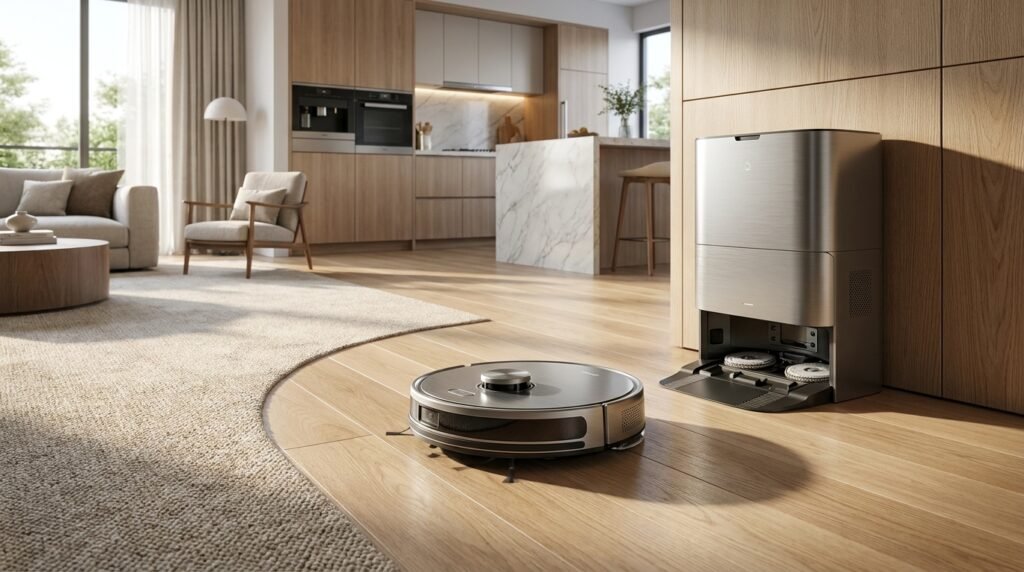
| Model | Best For | Approx. Price | Standout Feature |
|---|---|---|---|
| Roborock Saros 10R | Overall performance | Premium tier | Multiple solid-state LiDAR sensors, low-profile design |
| Dreame X60 Max Ultra Complete | All-around consistency | ~$1,499 (down from $1,699) | Slim redesigned body, strong pet hair and carpet scores |
| ECOVACS DEEBOT T80S Omni | Value shoppers | Mid-range | Strong scores close to premium models |
| Eufy Omni C28 | Budget buyers | Budget tier | Solid core cleaning without extras |
| Shark PowerDetect 2-in-1 | Most households | Under $1,000 | Self-emptying, self-mopping, AI stain detection |
Prices shift often with sales events, so treat these as a general guide rather than exact figures at checkout.
Roborock Saros 10R — Best Overall
Independent testing labs currently rank the Saros 10R as the top overall performer, largely because of how it handles obstacle avoidance without needing a bulky, tall body. Specifically, multiple LiDAR sensors let it recognize objects with better precision than earlier Roborock models, which matters most if you have a busy floor with cords, toys, or pet items lying around.
Dreame X60 Max Ultra Complete — Best Premium Pick
This model recently took over the top spot in monthly rankings from Vacuum Wars, ending a long run by an earlier Dreame flagship. Overall, it scores well across nearly every category — cleaning power, pet hair pickup, and obstacle detection — though testers note its navigation and battery efficiency are only average, not exceptional. Still, that’s a fair trade-off worth knowing before you spend premium money on it.
ECOVACS DEEBOT T80S Omni — Best Value
Sitting just below the flagship models in test scores, this robot delivers most of the performance without the flagship price tag. Overall, it’s a solid pick if you want strong cleaning and mapping without paying for every extra sensor.
Eufy Omni C28 — Best Budget Pick
For buyers who mainly want reliable daily vacuuming and don’t need advanced obstacle recognition, the Omni C28 covers the basics well. Admittedly, it won’t out-navigate a premium bot around a tangle of charging cables, but for straightforward homes it gets the job done.
Shark PowerDetect 2-in-1 — Best for Most People
Tested hands-on in a real household, this model handled a mix of debris — including Cheerios and kitty litter — with ease. In addition, its AI can detect stains and boost suction automatically, and the app makes it simple to name rooms, set no-go zones, and send the robot to spot-clean a specific area. Altogether, this comes in at under $1,000, which is why several reviewers call it the best pick for most people rather than the most “impressive” spec sheet.
What’s Coming Next (And What’s Still Just a Concept)
CES 2026 showed a few directions the category is heading, though none of these are widely available yet:
- Stair-climbing robots are moving from fantasy to prototype. Dreame’s Cyber X concept uses tank-like tread systems to climb steps up to nearly 10 inches, though it has no confirmed release date and testers remain cautious about how practical it’ll be day to day.
- Leg-based mobility is another early concept, with Roborock showing a robot that can extend and balance on leg-wheels to move between floors. Pricing and availability haven’t been announced.
- Aromatherapy and water electrolysis features are appearing on newer models, with claims of high germ-kill rates and adjustable scent release — features that are more about home ambiance than core cleaning performance.
Treat these as things to watch, not things to buy yet.
How to Choose the Right Robot Vacuum for Your Home
Homes With Pets
Look for models specifically tested for pet hair pickup and tangle-free brush rolls. Additionally, robots with strong obstacle avoidance matter more here, since pet waste and toys are common floor hazards.
Homes With Mostly Carpet
Suction power and brush design matter more than mapping precision in this case. Instead of trusting marketing claims about suction pascals, check independent carpet-performance scores, since real-world carpet pickup doesn’t always match the spec sheet.
A “Set It and Forget It” Setup
Prioritize a self-emptying, self-washing dock here. This is the single feature that most reduces weekly maintenance, even if it adds to the upfront cost.
Buying on a Budget
A mid-range model without advanced LiDAR can still clean effectively in simpler home layouts. Therefore, it makes sense to save the premium spend for homes with lots of furniture, cords, or pets.
Common Mistakes When Buying a Robot Vacuum
- Focusing only on suction power while ignoring navigation and mapping quality
- A confusing app can make even a great robot frustrating to use, so test it before buying
- Not every “self-emptying” dock works the same way; wash and refill quality varies a lot
- Brand support stability matters too, especially after industry changes like iRobot’s bankruptcy
Final Thoughts
There’s no single “best robot vacuum 2026” for everyone. For top-tier obstacle handling, the Roborock Saros 10R and Dreame X60 Max Ultra Complete lead current independent rankings. Meanwhile, if strong performance without flagship pricing is the goal, the ECOVACS DEEBOT T80S Omni is a smart middle ground. And for anyone who just wants something that handles daily mess with minimal fuss, the Shark PowerDetect 2-in-1 is hard to beat under $1,000. Ultimately, match the robot to your actual floors and habits, not just the spec sheet, and you’ll get far more value out of it.
FAQs
What is the best robot vacuum in 2026 overall?
Based on current independent testing, the Roborock Saros 10R ranks highest overall, thanks to strong obstacle avoidance and a low-profile design. The Dreame X60 Max Ultra Complete is a close competitor for premium buyers.
Is it worth buying a premium robot vacuum, or is a budget model enough?
It depends on your home. Premium models handle cluttered floors, cords, and pet hazards far better. If your home is simple and open, a budget model like the Eufy Omni C28 can handle daily cleaning just fine.
Are self-emptying robot vacuums worth the extra cost?
For most people, yes. Self-emptying docks cut down significantly on weekly maintenance, especially in homes with pets or longer hair.
Is iRobot Roomba still a safe brand to buy in 2026?
iRobot filed for Chapter 11 bankruptcy in December 2025, with Chinese manufacturer Picea Robotics announced as the buyer. Existing models still work, but it’s worth checking current warranty and support terms before purchasing.
Do robot vacuums work well on both carpet and hardwood floors?
Most modern robot vacuums automatically detect floor type and adjust suction, but performance still varies by model. Check independent carpet-specific test scores rather than relying on suction specs alone.
How much should I expect to pay for a good robot vacuum in 2026?
Budget models start under $400, solid mid-range options with self-emptying docks run roughly $700–$1,000, and premium flagships with advanced navigation range from $1,300–$1,700, though sales frequently bring these prices down.
For more updates visit: FUNDLY