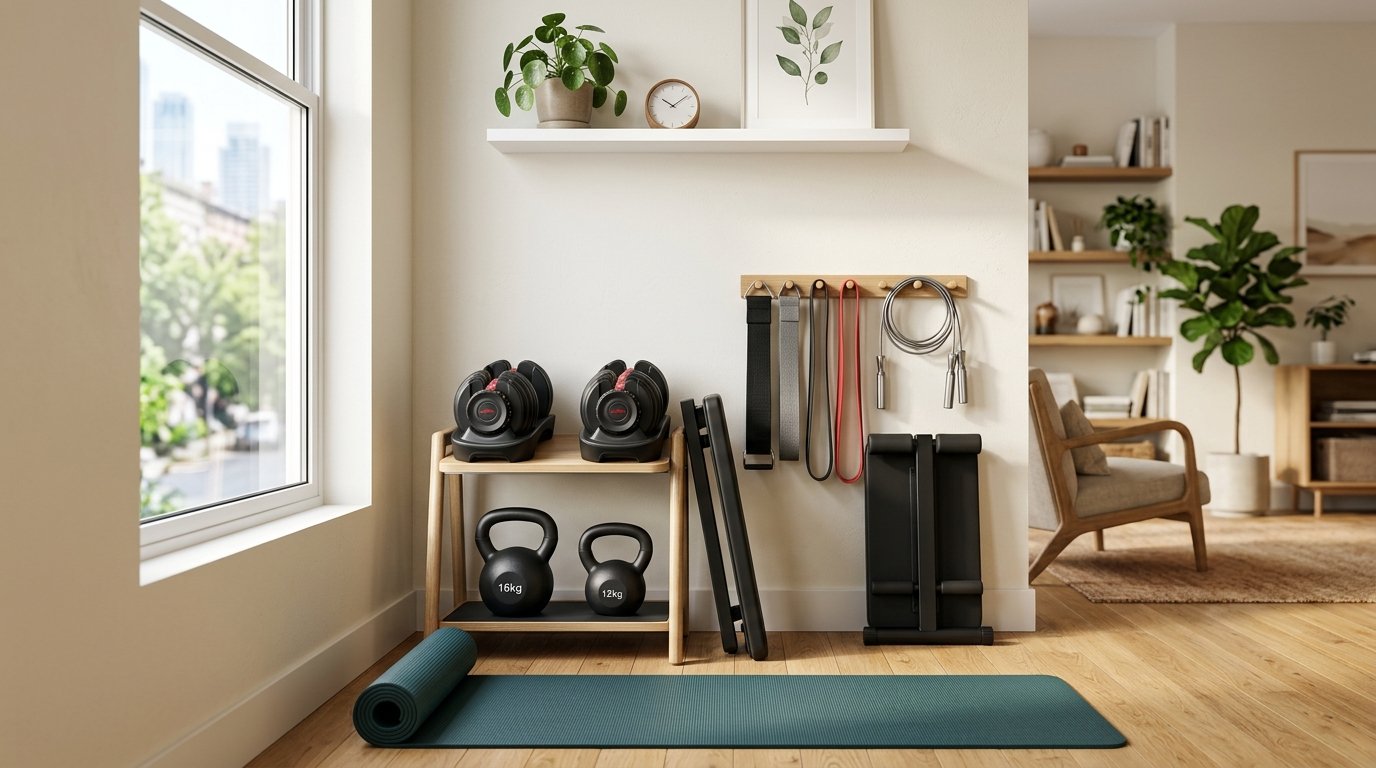
You don’t need a spare room to build real strength. You need a corner, a closet, and a few smart picks.
If you’ve ever tried to squeeze a treadmill into a studio apartment or balance dumbbells on a kitchen counter, you already know the problem: most fitness gear is built for garages, not apartments. The good news is that the best at home workout equipment for small space living has genuinely gotten better. Compact, multi-use gear can now replace an entire rack of weights or a bulky cardio machine, and most of it folds flat, hangs on a door, or slides under a bed when you’re done.
This guide covers what’s actually worth buying, what to skip, and how to build a full workout system in less than 10 square feet based on what fitness trainers, physical therapists, and real small-space users consistently recommend.
Why Small-Space Equipment Is Different From Regular Gym Gear
Regular home gym equipment is designed around one goal: performance. Small-space equipment has to solve two problems at once — performance and storage. That changes what “good” means.
When picking equipment for a tight apartment or shared living room, look for these traits:
- Foldable or collapsible design — benches, bikes, and racks that fold flat against a wall
- Multi-exercise versatility — one tool that replaces three or four machines
- Low floor footprint — ideally under 10 square feet when in use
- Easy one-person setup — no assembly team or permanent installation
- Quiet operation — important for apartments with thin walls or downstairs neighbors
Top Picks: Best At-Home Workout Equipment for Small Spaces
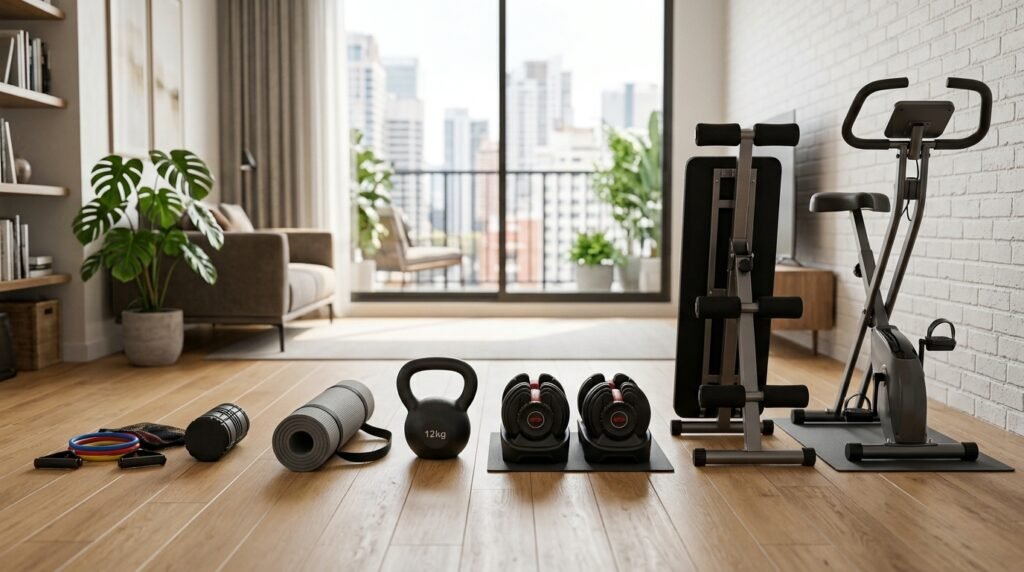
Here’s a practical breakdown of equipment that consistently earns high marks from trainers and small-space users, organized by what it’s actually good for.
1. Adjustable Dumbbells
Best for: Strength training without a weight rack.
A single pair of adjustable dumbbells (think 5–50 lbs per hand, changeable with a dial or pin) replaces what would otherwise be a dozen separate dumbbells taking up a whole shelf. Brands like Bowflex and PowerBlock have refined the dial mechanism enough that switching weights takes seconds, not fumbling.
Storage footprint: About the size of two shoeboxes stacked together.
2. Resistance Bands
Best for: Full-body training with zero floor space needed.
Resistance bands are the most underrated tool in home fitness. A set with varying tension levels, handles, and a door anchor can train your entire body — legs, back, shoulders, core — and rolls up into a bag smaller than a rolled towel. They’re also gentler on joints, which makes them a solid option for anyone easing back into exercise after time off.
3. A Suspension Trainer (like TRX)
Best for: Bodyweight strength and core stability.
A suspension trainer is basically two straps you anchor to a door or ceiling hook. From there, you can do rows, presses, lunges, and core work by adjusting your body angle instead of adding weight. It packs into a small pouch and takes under a minute to set up.
4. A Kettlebell (or Two)
Best for: Strength, power, and cardio in one tool.
One kettlebell can train more movement patterns than almost any other single object — swings, goblet squats, presses, rows, and carries. Because the weight is fixed, most people start with one moderate kettlebell (women often start around 8–12 kg, men around 12–16 kg) and add a second later if needed.
5. A Foldable Weight Bench
Best for: Anyone doing dumbbell or bodyweight strength work who wants an incline or flat surface.
Foldable benches have improved a lot — many now fold to just a few inches thick and lean flat against a wall or slide under a bed. Pair one with adjustable dumbbells and you have a surprisingly complete strength setup.
6. A Compact Cardio Option (Mini Stepper or Foldable Bike)
Best for: Low-impact cardio without a treadmill’s footprint.
A treadmill needs its own room in most apartments. A mini stepper or a vertical-folding exercise bike doesn’t. These stand upright in a corner when not in use and still give a solid cardio session, especially useful on rainy days or early mornings when going outside isn’t practical.
7. A Pull-Up Bar (Doorway Mounted)
Best for: Upper body and back strength.
A doorway pull-up bar installs without drilling in most cases and stores by simply removing it. It’s one of the few tools that trains your back effectively, an area resistance bands and dumbbells don’t hit as directly.
8. A Yoga or Exercise Mat
Best for: Everything else — stretching, core work, floor exercises.
It’s not glamorous, but a good mat is genuinely the foundation of a small home gym. It protects your floor, cushions your joints, and rolls up in seconds.
Comparison Table: Space vs. Value
| Equipment | Approx. Storage Space | Main Benefit | Good For |
|---|---|---|---|
| Adjustable dumbbells | 2 shoebox-sized units | Strength training | Beginners to advanced |
| Resistance bands | Fits in a small bag | Full-body, joint-friendly | All levels |
| Suspension trainer | Fits in a pouch | Core & bodyweight strength | Intermediate |
| Kettlebell | One compact weight | Strength + cardio combo | All levels |
| Foldable bench | Leans flat against wall | Adds incline/flat surface | Strength training |
| Mini stepper/foldable bike | Stands upright in corner | Low-impact cardio | Beginners, joint issues |
| Doorway pull-up bar | Removable, minimal storage | Back and upper body | Intermediate to advanced |
| Yoga mat | Rolls up small | Floor work, stretching | Everyone |
How to Build a Complete Small-Space Home Gym
You don’t need everything on this list. A realistic, budget-friendly starting combo looks like this:
- A yoga mat (foundation for floor work)
- One kettlebell or a set of resistance bands (strength and cardio)
- A doorway pull-up bar (back training)
- Adjustable dumbbells, added later as your budget allows
This combination covers strength, cardio, and mobility without needing more than a closet corner for storage.
People can also read this: 2026 Fashion Trends What’s Actually Worth Wearing This Year
What to Avoid
Not everything marketed as “space-saving” actually is. Be cautious with:
- Bulky all-in-one home gym towers — they promise variety but often need a permanent 6×6 ft footprint
- Under-desk ellipticals with vague resistance specs — read real user reviews, not just the product description
- Cheap resistance bands without reinforced handles — these snap quickly under regular use
A Balanced Note on Results
Equipment alone doesn’t build fitness — consistency does. Trainers generally agree that people are more likely to stick with a routine when the setup is simple and doesn’t require moving furniture every time. That’s really the core advantage of small-space equipment: it lowers the friction between deciding to work out and actually doing it. The equipment matters less than whether you’ll actually use it three or four times a week.
Final Thoughts
The best at home workout equipment for small space living isn’t about buying the most expensive gear — it’s about choosing tools that fold away, adapt to multiple exercises, and fit realistically into your daily life. Start with one or two pieces, build a habit, then expand. A tiny apartment corner can absolutely support a real, effective fitness routine.
FAQs
What is the best at-home workout equipment for a small apartment?
Adjustable dumbbells, resistance bands, a kettlebell, and a yoga mat are generally the best starting combination. Together they cover strength, cardio, and mobility while taking up very little storage space.
Can I build muscle with small-space equipment only?
Yes. Muscle growth depends on progressive overload — gradually increasing resistance over time — which adjustable dumbbells, resistance bands, and kettlebells can all provide effectively.
Do I need cardio equipment if I already walk or run outside?
Not necessarily. If you get regular outdoor cardio, a compact cardio machine is optional. It becomes more useful for bad weather days or early mornings when going outside isn’t convenient.
How much space do I actually need for a home gym?
Most compact setups fit in under 10 square feet when in use, and much less when stored. A yoga mat, a kettlebell, and resistance bands can all be stored in a small closet or under a bed.
Are foldable exercise bikes worth it for small apartments?
They can be, especially vertical-folding models that stand upright in a corner. Check the resistance levels and noise rating before buying, since quality varies a lot between brands.
What’s the single best piece of equipment to start with?
If you can only buy one thing, a set of resistance bands or a single kettlebell offers the most exercise variety for the lowest cost and smallest storage footprint.
For more updates visit: FUNDLY