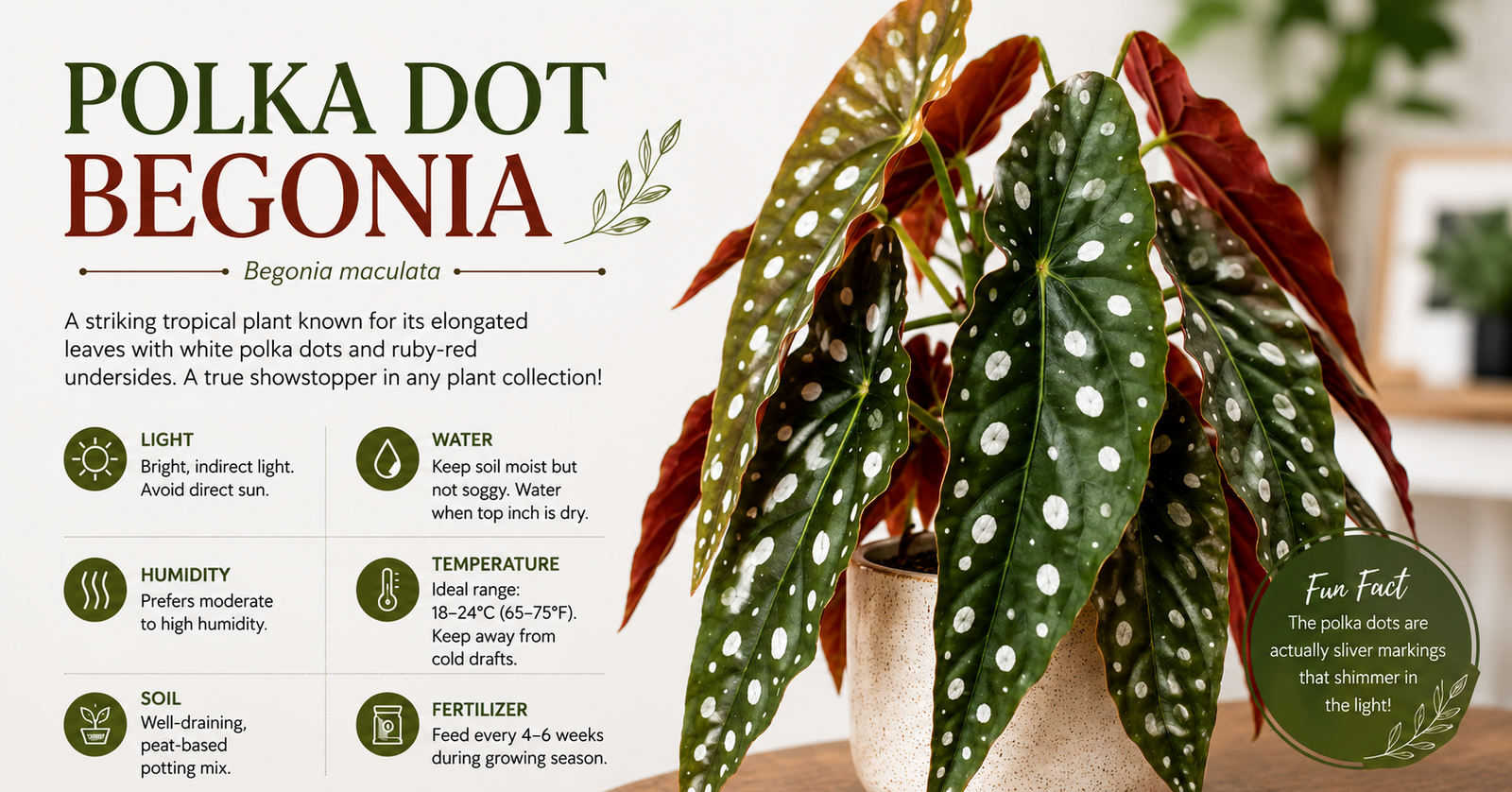
The first time you see a polka dot begonia in person, you’ll probably touch a leaf just to check it’s real. The silvery-white spots look printed on. The undersides flash a deep wine-red. It’s one of those houseplants that photographs well but somehow looks even better in your living room.
If you’ve just brought one home or you’re eyeing one at the nursery and wondering if you can actually keep it alive this guide covers everything from light and water to the mistakes that kill most polka dot begonias in their first six months.
What Is a Polka Dot Begonia?
The polka dot begonia’s botanical name is Begonia maculata. It’s a cane-type begonia, meaning it grows upright on thick, jointed stems rather than trailing or clumping like other begonias. In its natural habitat the Atlantic rainforests of Brazil it grows in the dappled shade beneath taller trees, which explains a lot about how it behaves indoors.
Its leaves are long, asymmetrical, and shaped a bit like angel wings, which is why you’ll also see it called the angel wing begonia. The top surface is olive to dark green with rows of silvery-white dots, and the underside is a rich maroon or burgundy red. Left to mature, a healthy plant can reach around two to three feet tall indoors, sometimes more with support.
It’s also mildly toxic if eaten by pets or people, so keep it out of reach of curious cats, dogs, and toddlers.
Is the Polka Dot Begonia Hard to Grow?
Here’s the honest answer: it has a reputation for being fussy, but it’s really more “particular” than difficult. Most problems come down to one of two things inconsistent watering or not enough light. Once you get those two right, this plant is fairly forgiving.
Think of it less like a delicate orchid and more like a plant with a short list of non-negotiables. Meet those, and it grows steadily; ignore them, and it sulks fast, usually by dropping leaves.
Polka Dot Begonia Care at a Glance
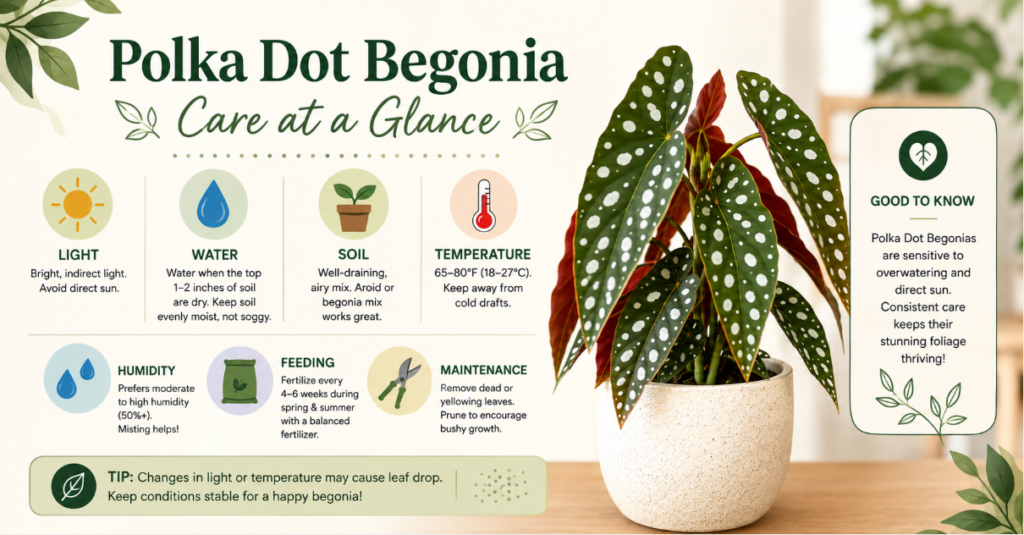
| Care Factor | What It Needs |
|---|---|
| Light | Bright, indirect light; no direct midday sun |
| Water | When the top inch of soil is dry; never soggy |
| Humidity | 50% or higher works best |
| Temperature | 65–75°F (18–24°C), no cold drafts |
| Soil | Well-draining potting mix with perlite or orchid bark |
| Fertilizer | Balanced liquid feed monthly, spring through summer |
| Toxicity | Mildly toxic to pets and humans if ingested |
Light: The Detail Most People Get Wrong
A polka dot begonia wants bright, filtered light, not direct sun. An east-facing window, or a spot a few feet back from a south or west-facing one, usually works well. Sheer curtains help soften harsh afternoon sun.
You can actually read the plant’s light levels in its leaf undersides. Deep red undersides usually mean it’s getting good light. If the undersides look pale or mostly green, it’s a sign to move the plant somewhere brighter. Too little light also causes “legginess” long, bare stems with sparse leaves stretching toward the nearest window.
Watering: Consistency Over Perfection
This is where most polka dot begonias run into trouble. The plant likes soil that stays lightly moist, but it will rot quickly if left sitting in water. The simplest approach is the finger test: push a finger into the top inch of soil, and water only when that top layer feels dry.
A few practical tips:
- Always use a pot with a drainage hole. Without one, excess water has nowhere to go.
- Water thoroughly until it runs from the drainage hole, then empty the saucer. Don’t let the pot sit in standing water.
- Water less in winter, when growth slows down naturally.
- Room-temperature water is gentler on the roots than cold tap water straight from the fridge or a cold pipe.
Yellowing, mushy leaves usually point to overwatering. Crispy, curling leaves point the other way underwatering or low humidity.
Humidity: Why Some Begonias Struggle in Dry Homes
Coming from a rainforest floor, this plant is used to humid air, ideally somewhere around 50% or higher. Average home humidity, especially with central heating or air conditioning running, often sits lower than that.
Signs your begonia wants more humidity include dry, browning leaf edges or crispy tips. A few realistic fixes:
- Group it with other houseplants to raise the local humidity.
- Set the pot on a pebble tray with water (without letting the pot touch the water directly).
- Run a small humidifier nearby, especially in winter.
- Bathrooms or kitchens with natural light can work surprisingly well if humidity is otherwise hard to manage.
Misting is popular advice, but it’s a short-term fix at best the humidity boost fades within minutes, and wet leaves left overnight can invite fungal problems.
Soil and Repotting
A loose, well-draining mix matters more than a fancy one. A standard indoor potting mix with added perlite, orchid bark, or coarse sand tends to work well, since it lets excess water drain while still holding some moisture. Because the plant doesn’t develop a large root system, it rarely needs a huge pot sizing up gradually, roughly once a year in spring, is usually enough.
Feeding
During the active growing months (spring and summer), a balanced, water-soluble houseplant fertilizer once a month supports steady growth. Cut back or stop feeding in autumn and winter when the plant naturally slows down; feeding a dormant plant does more harm than good.
Common Polka Dot Begonia Problems (and Realistic Fixes)
| Problem | Likely Cause | What to Do |
|---|---|---|
| Yellow, mushy leaves | Overwatering or poor drainage | Let soil dry out more between waterings; check for a drainage hole |
| Brown, crispy edges | Low humidity or underwatering | Increase humidity; check watering schedule |
| Leggy growth, few leaves | Not enough light | Move to a brighter spot; consider a grow light |
| Dropped leaves after moving it | Transplant/relocation shock | Keep conditions stable; avoid moving it again too soon |
| Powdery white patches | Powdery mildew (too little airflow/humidity too high on leaves) | Improve air circulation; avoid wetting leaves |
| Small cottony white spots | Mealybugs | Wipe with a cotton swab dipped in rubbing alcohol; isolate the plant |
If you’re consistently doing everything “right” and the plant still looks unhappy, it’s worth double-checking the pot has drainage and that the plant isn’t sitting near a heating vent, drafty window, or air conditioner temperature swings stress it just as much as watering mistakes.
How to Propagate a Polka Dot Begonia
Propagation is one of the easiest, most rewarding parts of owning this plant, and it’s a great way to fill out a leggy specimen or share cuttings with friends.
- Snip a stem cutting just below a node (the small bump where a leaf attaches), ideally with at least one or two leaves.
- Place the cutting in water or moist soil, keeping it out of direct sun.
- If rooting in water, change it every few days and watch for roots to appear within a couple of weeks.
- Once roots are an inch or two long, pot the cutting into a well-draining mix.
- Keep humidity high around the new cutting for the first few weeks a loosely covered container or humidity dome helps.
Regular pruning of leggy stems, done with clean, sharp scissors, also encourages a bushier, fuller plant over time rather than one tall, sparse cane.
Polka Dot Begonia vs. Other Popular Begonias
People sometimes confuse the polka dot begonia with rex begonias or other spotted varieties. The quickest way to tell them apart: Begonia maculata has narrow, pointed, angel-wing-shaped leaves with silver dots, grows on upright canes, and has red leaf undersides. Rex begonias, by comparison, tend to have broader, more rounded leaves with swirling colour patterns and grow closer to the soil in a rosette shape rather than on tall canes.
Final Thoughts
A polka dot begonia rewards attention without demanding constant fussing. Get the light bright but indirect, let the soil dry slightly between waterings, and give it a bit of extra humidity, and it will settle into a steady rhythm of new leaves through spring and summer. It’s not a “set it and forget it” plant, but it’s not a nightmare either it just wants a fairly specific, fairly simple routine.
FAQs
Is the polka dot begonia easy to care for?
It’s manageable for most indoor gardeners once you understand its two main needs: bright indirect light and evenly moist (not soggy) soil. It’s more particular than truly difficult.
Why is my polka dot begonia dropping leaves?
Leaf drop is often caused by a sudden change in environment a move, a draft, or a big temperature swing or by inconsistent watering. Keep conditions stable and check your watering routine first.
Does polka dot begonia need direct sunlight?
No. Direct sun, especially midday sun, can scorch its leaves. It prefers bright, filtered or indirect light instead.
How often should I water my polka dot begonia?
There’s no fixed schedule water when the top inch of soil feels dry, which might be every few days in summer and much less often in winter, depending on your home’s conditions.
Is polka dot begonia toxic to cats and dogs?
Yes, it’s considered mildly toxic to pets if ingested. Keep it somewhere out of reach if you have curious animals in the house.
Why aren’t the leaf undersides very red on my plant?
Pale or greenish undersides usually mean the plant isn’t getting quite enough light. Moving it to a brighter (but still indirect) spot often brings the red colour back over the next few weeks.
For more updates visit: FUNDLY